Showing posts with label joe kaufman. Show all posts

Thursday, April 26, 2012

Joe Kaufman's Big Book About the Human Body


As a special treat for any Vintage Children's Books My Kid Loves readers who might stop by today, here's a third Joe Kaufman Big science book, following on About How Things Work and About Earth and Science. I had this book as a child and I read it over and over and over again. I could have scanned something from nearly every page, but I mostly selected images that not only stuck with me all this time but were recalled with regularity during the intervening years.

In case anyone's counting, Joe Kaufman's Big Book About the Human Body is Golden Press publication 16843; it was originally published under the title Joe Kaufman's How We are Born, How We Grow, How Our Bodies Work, and How We Learn; and the LOC description reads: "Introduces the parts of the body and their functions and discussions relevant topics such as health, heredity, dreams, and food."

The introductory note on the table of contents page reads: "A NOTE TO PARENTS: This book has been designed to give children an understanding of their bodies--and to help parents answer the many questions they ask. It provides a basic introduction to all the body structures and their functions, and also covers a variety of related topics. The book is primarily for young readers from six to twelve, who will find ideas and concepts to fascinate them at every stage of their growth. The whole family, in fact, will enjoy reading and sharing the information offered here."

The topics listed in the table of contents are: Early ideas about the body, the newborn baby, a baby begins, the baby-to-be, heredity, growing up, cells, bones (including skull, rib cage, pelvis, spine, leg bones, arm bones), evolution, muscles (including chest, back, arm, leg, neck, foot, organ and face muscles), exercise, hands, organs, heart, blood, circulation, lungs, voice, mouth, stomach, intestines, liver, gall bladder, pancreas, spleen, kidneys, bladder, lymphatic system, food (including proteins, vitamins and minerals, carbohydrates and fats), ductless glands, nervous system, brain, learning, learning experiments, sleep and dreams, the senses, sight, hearing, balance, smell, taste, touch, pain, skin, skin color, hair, tooth care, keeping clean, body temperature, sickness, colds, fevers, earaches, rashes, toothaches, healing, discoveries in medicine, the future.


Germ cells, gendered hats, heredity, done.

1. THIS KID? One of the cutest ever. 2. What more information could a kid need to grasp how various traits passed through families?

Always loved how the kid was giving the brain cell the stink-eye. The green liver cell on the left reminds me of a giant squid. I don't think I ever had an image of cells that was more complex than this until well into AP Biology.

This sequence just seems like quintessential Kaufman humor to me.

It's the dog-food dog that really puts this one over the top.

I have a very clear memory of being on a plane and seeing a woman with very curly hair and telling my mom, "She has flat hair follicles!!"

Again, I was well into AP Biology before I had any more complex vision of the immune system than this. If fact, when I get a bloody paper cut, I still envision blood cells engaged in hand-to-hand combat.

I've never really gotten over the weirdness of the box bath, all these years later. (Kaufman illustrated the Hygiene section with a gallery of bathing styles through the ages.)

"In 1822, Dr. William Beaumont studied digestion by watching a patient's stomach through an unhealed wound." Like...WHAT?! I can't even deal, people. I can't even deal.


Does anybody want to see Mammals & Birds or Slimy, Creepy, Crawly Creatures? I'd say both are a notch slightly below his other three science books, quality-wise, but they still have a lot to offer. Let me know if there's interest and I'd be happy to scan pages from one or both.


Sunday, March 25, 2012

Joe Kaufman's Big Book About Earth and Space

Joe Kaufman's Big Book About Earth and Space - Golden Book 16845 - Published 1987.
So after I discovered Joe Kaufman's Big Book About Things Work, I decided (in the interests of the child's future STEM education, of course) that I had to have his other "big" science books. I got our scanner set up (whee!), so here are some selections from his Big Book About Earth & Space, which was originally published as Joe Kaufman's About the big sky, about the high hills, about the rich earth...and the deep sea.

It's basically a combination earth science and astronomy book, and the topics covered are: Early ideas about our world, the stars, the planets, the sun, the moon, the earth, gravity, energy from the sun, the air or atmosphere, the weather, weather instruments, clouds, lightning, thunder, tornadoes, hurricanes, blizzards, the seasons, climate, plains, plateaus, hills, mountains, mountain climbing, trees, forests, jungles, deserts, the polar zones, moving continents, earthquakes, volcanoes, underground, caves, rocks, minerals, crystals, water, the oceans, seashores, rivers and lakes, ponds, bays, streams and the Future (featuring, of course, Kaufman's trademark future people wearing personal antennas).


Life without gravity looks way more fun, yes?

This 1970s weatherman has such character.


There's waaaay too much going on this illustration, but the energy and whismy (and the emo animals) are a good example of Kaufman's overall illustration style.

In addition to How Things Work, Human Body and Earth & Space, I've found Joe Kaufman's Big Book About Mammals and Birds and Joe Kaufman's Slimy, Creepy, Crawly Creatures, which covers invertebrates, insects, fish, reptiles and amphibians. Are there any other Kaufman books out there that you've enjoyed? Inquiring minds want to know!

Friday, March 2, 2012

Joe Kaufman's Big Book About How Things Work

Joe Kaufman's Big Book About How Things Work - front cover

I wasn't even sure what I had in my hands when I found Joe Kaufman's Big Book About How Things Work at Savers in Vegas, but I instantly recognized the style of the book as being the same as the style of my beloved childhood human-body book, which I mentally refer to to this day. Seriously, if you tell me anything about the immune system, I still visualize a bunch of little white blood droplets looking very angry on their way to battle. A little web research reveals that that book, now lost to me, must have been Joe Kaufman's Big Book About the Human Body or the earlier version Joe Kaufman's How We are Born, How We Grow, How Our Bodies Work, and How We Learn.

Anyway, this guy is just so fantastic. There is virtually no information about author-illustrator Joe Kaufman online, but according to the copyright notice inside the book he was born in 1911, so he's either 100 years old or...not. Suffice it to say, this book is just a wonderful, charming and funny introduction to mechanical engineering and gadgets and applied science, and so help me I've learned a lot just in the last 24 hours of owning this book!

No lie, Jackson had his first-ever hissy-fit at the airport when they took his stroller away to put it in the cargo hold. He was bereft, but I whipped out this book (which I was carrying with me because my suitcase full of Savers loot had hit the 50 lb. weight limit), and I showed him this cutaway of a passenger plane, and suddenly he was all better. "Stroller under plane? Stroller under plane."
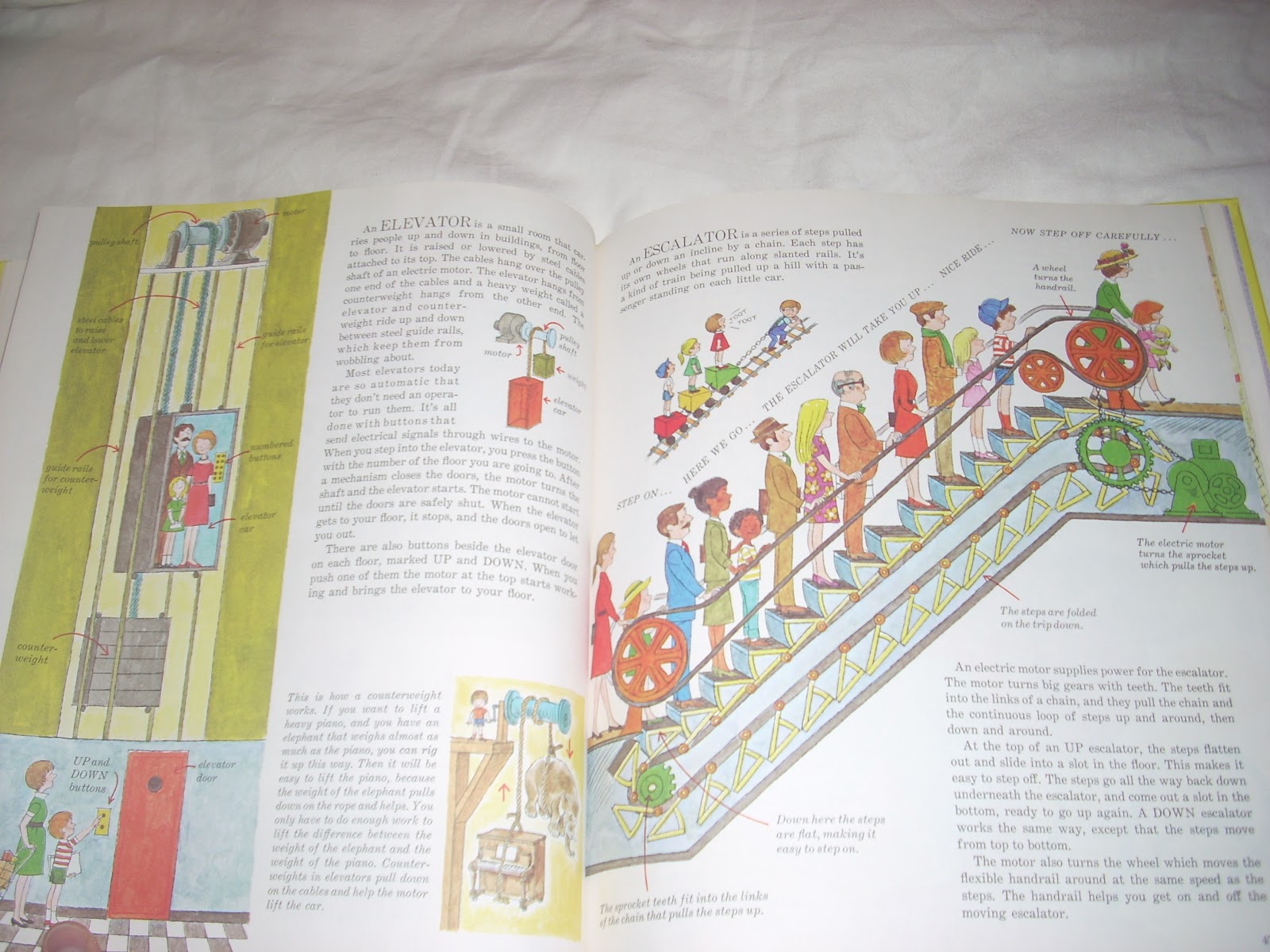
Elevators and escalators explained, with help from a few 1970s haircuts and outfits. This book was originally published in 1971 as Joe Kaufman's What Makes It Go? What Makes It Work? What Makes It Fly? What Makes It Float? This version is the retitled 1987 reprint. There is still very much the flavor of 1971 in the attitude and illustrations, so I assume it wasn't too dramatically revised.

"Guess which one of these astronauts was the first man to step on the moon?"

Here is the obviously Space Race-influenced introduction to the book:

A NOTE TO PARENTS: This book was designed to help answer one of the most frequently asked questions of childhood--"What makes it work?" It is a basic introduction to the mechanics, and the concepts behind the mechanics, of a variety of appliances, machines, and vehicles. Although it was designed primarily for young readers from six to ten, older children and adults will surely find much to learn and enjoy. In fact, the entire family can share many exciting and rewarding hours studying the great ideas of inventors of the past as they are incorporated into the things we use today. We hope the book will awaken the child's interest in the roles science and technology play in giving us the things we take for granted, and perhaps encourage him to go on to more detailed works in areas of particular interest. It may also be a beginning for those who will one day make the discoveries that lie ahead.

Two young ladies playing dress-up go head-to-head in the great domestic war over electric versus gas stoves.
Look at this cuckoo collection of cuckoo clocks!
Embarrassing confession: At first thought these guys were the Three Stooges, but no, that's Chico, Harpo (on the harp) and Groucho Marx demonstrating three musical instruments. (Tuba, clarinet and harmonica are explained on the next page, with no further assistance from the Marx brothers.)
Example four on the tape recorder uses page: "A tape recorder is useful to international spies...for recording important diplomatic secrets." 
I just think the kaleidoscope images are beautiful, and so precise!
"Oh wow! the FUTURE" pretty much predicts the iPad and ubiquitous personal computing. Joe Kaufman wins!
Joe Kaufman's Big Book About How Things Work - back cover, with a few more cute illustrations